How to Clean an Oven Without Harsh Chemicals (Baking Soda Method)
By Samer Alsayegh · · 12 min read
Key Takeaways
- Spread baking soda paste inside the oven. Leave it for at least 12 hours.
- Spray vinegar on leftover paste. It foams and wipes off easily.
- Most store oven cleaners contain lye. Lye can burn skin and eyes.
- Soak racks overnight in a tub of hot, soapy water.
- Do a full oven clean every 3 to 6 months.
To clean an oven without harsh chemicals, take out the racks and spread a paste of baking soda and water over the inside. Let it sit for at least 12 hours. Wipe it off with a damp cloth, then spray white vinegar on any white residue and wipe again. It takes about 30 minutes of real work, plus an overnight wait.
Most store-bought oven cleaners work fast because they contain lye. That's sodium hydroxide or potassium hydroxide, the same stuff in drain cleaner. It can burn skin and eyes, and the fumes are hard on your lungs. The baking soda method is slower, but it's cheap, safe around kids and pets, and works on most baked-on grease. This guide covers the full method, the racks, the glass door, and how to keep the mess from coming back. Ezi Home Services books deep cleans in Ottawa, Toronto, Montreal, and other cities, and this is the same low-fume approach many service providers use.
Why skip commercial oven cleaner?
Most heavy-duty oven cleaners are corrosive. They're labelled as able to cause severe skin burns and eye damage, and they can corrode metal. In Canada, those products carry a corrosive hazard symbol on the label, framed in an octagon (danger), a diamond (warning), or an inverted triangle (caution).
The active ingredient is usually lye. The US National Library of Medicine notes that sodium hydroxide can cause severe burns and lasting damage to any tissue it touches. A UK study of calls to its National Poisons Information Service found that 96 percent of oven cleaners involved in exposures contained sodium or potassium hydroxide. Most people who breathed in the spray had symptoms.
That doesn't mean you can never use one. But you need gloves, eye protection, open windows, and no kids or pets nearby. For a normal oven that gets cleaned a few times a year, you don't need that much firepower. Baking soda does the job with a little more time.
Never mix oven cleaner with other products, either. Our guide to cleaning chemicals you should never mix explains why.
What you need
You only need a few basic items. Most are already in your kitchen:
- Baking soda, about half a cup.
- Water.
- White vinegar in a spray bottle.
- Dish soap.
- A plastic or silicone spatula or scraper.
- Rubber gloves.
- Microfibre cloths or old rags.
- A non-scratch scrub pad.
- An old towel or a large trash bag for the racks.
Skip steel wool and metal scrapers. They scratch the enamel inside the oven. Once enamel is scratched, grease sticks to it even faster.
How to clean an oven with baking soda, step by step
This is the main method. Plan to start in the evening and finish the next morning.
Step 1: Empty the oven and check the type
Take out the racks, the pizza stone, the thermometer, and anything else inside. Let the oven cool fully if you just used it.
Check your manual or the inside of the door for the oven type. A standard enamel oven is fine for this method. Some ovens have a special coating, like a "steam clean" or "continuous clean" finish. Those may need a gentler approach, so check the maker's advice first.
Step 2: Mix the paste
In a small bowl, mix about half a cup of baking soda with 3 to 4 tablespoons of water. Add water a little at a time until you have a paste that spreads like thick frosting. Too runny, and it slides down the walls. Too dry, and it won't stick.
Step 3: Spread the paste
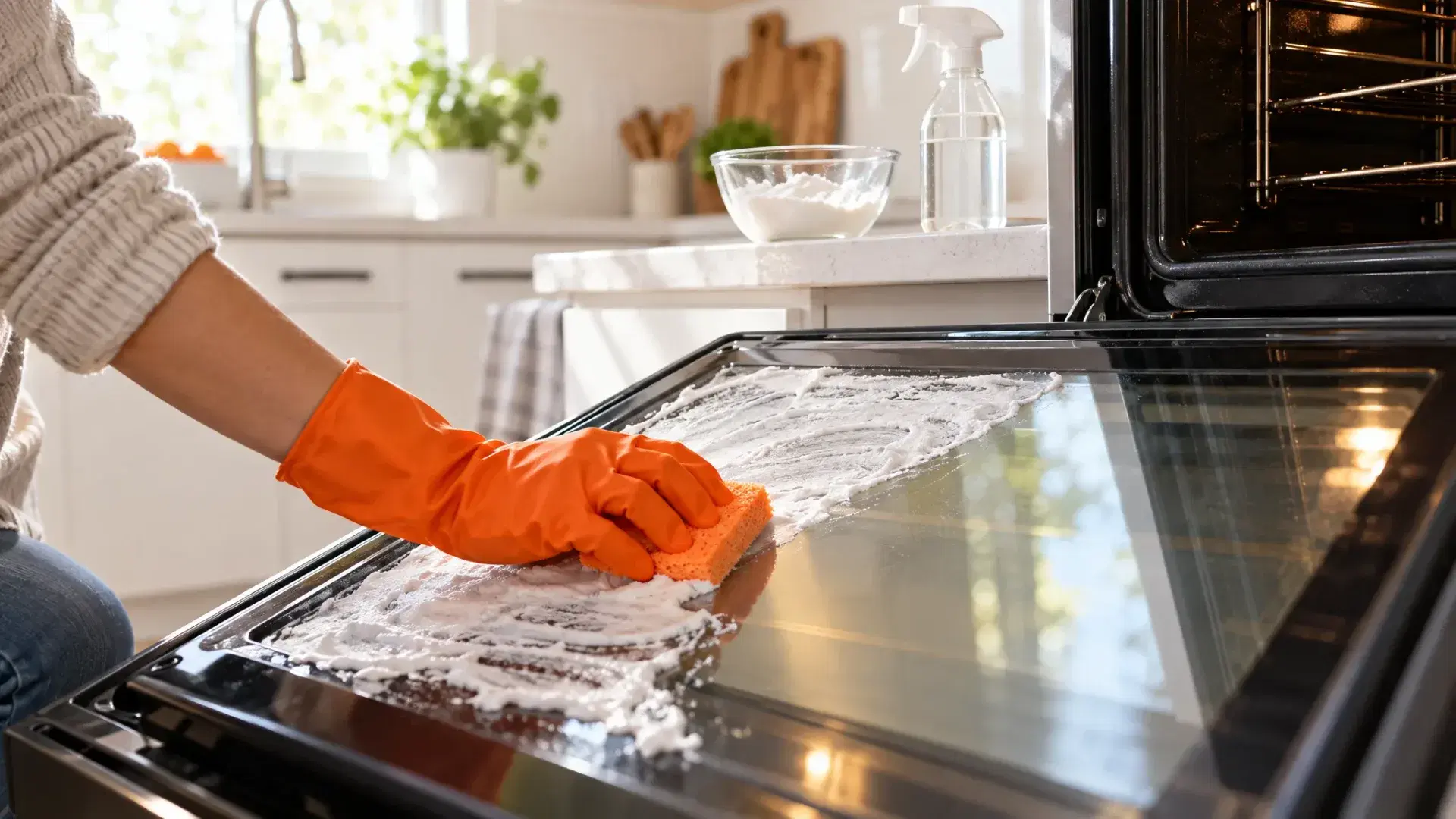
Put on gloves. Spread the paste over the bottom, sides, back, and inside of the door. Use your fingers or a soft brush. Go thicker on the worst spots. The paste will turn brown in places as it touches grease. That's normal.
Keep the paste off the heating elements, the gas burner ports, and the fan in a convection oven. Baking soda stuck there can smoke the next time you cook.
Step 4: Let it sit overnight
Close the door and leave the paste for at least 12 hours. This is where the work happens. Baking soda is a mild alkali. Over time, it softens and loosens fat and burnt-on food so it lifts off with a cloth.
Use this time to soak the racks. See the next section.
Step 5: Wipe out the paste
The next day, take a damp cloth and wipe out as much paste as you can. Use the plastic scraper for hard spots. Rinse the cloth often. You'll see most of the grime come off with the paste.
Step 6: Spray with vinegar
Spray white vinegar anywhere you still see white baking soda residue. The vinegar reacts with the baking soda and foams a little. That foam helps lift the last of the film.
Step 7: Final wipe and dry
Wipe the foam away with a clean, damp cloth. Repeat until no white film is left. Dry the inside with a dry towel. Put the racks back in, and you're done.
If a few spots are still stuck, add a second, thicker layer of paste just on those areas. Let it sit a few hours, then scrub with a non-scratch pad.
How to clean oven racks
Oven racks are often the hardest part because they're too big for the sink. The bathtub works well.
- Lay an old towel in the bottom of the tub so the racks don't scratch it.
- Put the racks on the towel.
- Fill the tub with hot water until the racks are just covered.
- Add about half a cup of dish soap, or a cup of laundry detergent powder.
- Let them soak overnight, at least 8 hours.
- Scrub with a non-scratch pad or an old toothbrush. Rinse and dry fully.
No tub? Put each rack in a large trash bag with a paste of baking soda and a splash of vinegar. Tie it shut and leave it overnight. Then scrub and rinse outside with a hose.
Dry racks well before putting them back. Water spots can lead to rust on older chrome racks.
How to clean the oven door glass
The inside of the glass collects a brown, baked-on film. The baking soda paste works here too.
Spread a thin layer of paste on the inside of the glass. Let it sit for 15 to 20 minutes, or longer for heavy build-up. Scrub gently with a damp non-scratch pad. Then wipe with a damp cloth and buff dry. For any streaks, spray a little vinegar and wipe with a dry microfibre cloth.
Some ovens have grime between the two panes of glass. That usually happens when liquid drips through the vent slots at the top of the door. On many models, the inner glass comes off with a few screws. Check your manual before you take the door apart. If you're not sure, leave it to a pro.
Does the outside of your oven have a stainless steel front? Our guide on how to clean stainless steel appliances without streaks covers the outside.
Faster spot fixes for fresh spills
You don't always need the overnight method. For a fresh spill, catch it early.
- While the oven is warm, not hot: sprinkle salt on a fresh liquid spill. The salt soaks it up and makes it easy to wipe once the oven cools.
- For a small burnt spot: make a small dab of paste, leave it for 20 minutes, and scrub.
- For a greasy film: wipe with warm water and a few drops of dish soap, then rinse with a clean cloth.
For grease on the stovetop, cupboards, and backsplash, our guide on how to remove grease stains from kitchen surfaces has more tips.
What about the self-clean cycle?
Many ovens have a high-heat self-clean setting that burns residue to ash. It works, but it makes fumes that can harm pet birds, and it's hard on parts like the thermal fuse. Our guide on whether self-cleaning ovens actually work covers the risks, costs, and how to run it safely.
How often should you clean your oven?
Most home ovens need a full clean every 3 to 6 months. Clean it sooner if you see smoke when you preheat, smell burning food, or see thick, black build-up on the bottom.
| Task | How often |
|---|---|
| Wipe up fresh spills | After each use, once cool |
| Wipe the door glass | Every 1 to 2 weeks |
| Full baking soda clean | Every 3 to 6 months |
| Clean the racks | Every 3 to 6 months |
If you roast or bake often, you may need to deep clean closer to every 3 months. If you mostly use the stovetop, twice a year is usually enough.
The underused tip: stop the mess before it starts
The cheapest oven clean is the one you never have to do. Most of the baked-on mess comes from a few common habits. Fix those, and your full clean every few months gets much easier.
- Put a baking sheet on the rack below pies, casseroles, and anything that might bubble over. Don't line the oven floor with foil. Many makers warn that foil on the bottom can block heat and damage the finish.
- Cover roasting pans with a lid or foil when cooking fatty meats. That keeps grease from spitting onto the walls.
- Wipe spills once the oven cools, the same day. Fresh spills come off with a damp cloth. Once they bake on a few more times, they turn to carbon.
- Use the right size dish. A dish filled to the brim is much more likely to boil over.
These habits take a few seconds each. Over a few months, they save you a lot of scrubbing.
Methodology
Safety information on oven cleaner comes from the US National Library of Medicine and a UK National Poisons Information Service study of oven cleaner exposures. Canadian label symbols reflect the Consumer Chemicals and Containers Regulations. The baking soda method reflects widely published home cleaning guidance. Cleaning schedules reflect common household practice.
When to call a professional
The baking soda method handles most ovens. But some jobs are worth handing off. Call a pro if the oven hasn't been cleaned in years, if grime is stuck between the door glass, or if you're moving out and need the oven spotless for a landlord.
An oven clean is usually part of a deep cleaning service or a move-out clean, not a standard visit. See what's covered in a professional kitchen cleaning service. You can book a deep clean with Ezi in a few taps, with an upfront price and a set arrival window.
The bottom line on cleaning your oven
You don't need harsh chemicals to get a clean oven. Spread a baking soda paste, wait 12 hours, wipe it out, and finish with vinegar. Soak the racks in the tub at the same time. Clean the glass with the same paste.
Do a full clean every 3 to 6 months, and wipe spills as they happen. Put a tray under anything that might bubble over. With those habits, your oven stays clean with very little effort. For the rest of the room, see the fastest way to clean a kitchen from top to bottom.
How To
Frequently Asked Questions
What's the best way to clean an oven?
For most home ovens, baking soda paste works best. Spread it inside, leave it overnight, then wipe it off and spray vinegar on what's left. It lifts baked-on grease without the lye in heavy-duty oven cleaners. Self-clean works too, but it smokes and strains oven parts.
How do you clean an oven step by step?
1. Take out the racks and soak them in hot, soapy water. 2. Spread baking soda paste inside, skipping the heating element. 3. Leave it 12 hours. 4. Wipe it off with a damp cloth. 5. Spray vinegar on the white film and wipe again. 6. Clean the door glass, then dry and replace the racks.
How do you deep clean an oven?
A deep clean covers the inside walls, the door glass, the racks, and the edge around the door gasket. Use the baking soda method inside and soak the racks overnight. Do it every 3 to 6 months, or sooner if the oven smokes when it preheats.
How long should baking soda sit in the oven?
Leave baking soda paste in the oven for at least 12 hours, or overnight. That gives it time to soften baked-on grease. For very heavy spots, add a second layer and wait a few more hours.
Can you clean an oven with baking soda and vinegar?
Yes, but not mixed in a jar. Spread baking soda paste first and let it sit. Then spray vinegar on the leftover paste. The two foam together and help lift the last white film.
Is oven cleaner dangerous?
Many heavy-duty oven cleaners contain lye, also called sodium hydroxide. It can cause severe burns to skin and eyes. If you use one, wear gloves and eye protection, and open the windows.
How do you clean the inside of an oven door glass?
Spread a thin layer of baking soda paste on the glass and leave it for 15 to 20 minutes. Scrub gently with a damp non-scratch pad. Wipe clean and buff dry with a microfibre cloth.
How do you clean oven racks without chemicals?
Soak the racks overnight in a bathtub of hot water with half a cup of dish soap. Lay a towel down first to protect the tub. Then scrub with a non-scratch pad and rinse.
How do you clean an electric stovetop?
Let it cool first. On a glass top, sprinkle baking soda, lay a hot damp towel over it for 15 minutes, then wipe. Scrape burnt spots with a razor scraper held at a low angle. On a coil top, lift out the coils, wipe them with a damp cloth, and soak the drip pans in hot, soapy water.
How do you clean a hob?
A hob is the British word for a stovetop. On a glass or ceramic hob, use baking soda and a hot damp towel, then a razor scraper for burnt spots. On a gas hob, soak the grates and burner caps in hot, soapy water and wipe the surface. Never use steel wool on glass.
What is the best oven cleaner?
For regular upkeep, baking soda paste is the best choice: it's cheap, fume-free, and safe on enamel. Lye-based sprays work fastest on thick, years-old grease, but they need gloves, eye protection, and open windows. Fume-free formulas sit in between. With Ezi, oven cleaning is an add-on to a deep or move-out clean.
oven cleaning
kitchen cleaning
baking soda
natural cleaning
deep cleaning
Written by
Home Cleaning · Maintenance
Co-founder of Ezi Services and Draftbase, entrepreneur and builder focused on SaaS, AI, and growth — I turn ideas into scalable businesses using technology, automation, and relentless execution.